

That Time I Responded to Our Bishop’s Misguided Charlie Kirk Statement
Like many who witnessed Charlie Kirk’s assassination on September 10, 2025, I shared my shock, fear, and hopelessness online. In that post, I also wrote about how my experience growing up in a country where political violence and assassinations are common has unfortunately shaped how I view what’s been happening in the United States since then. It’s not a perspective I wish on anyone, and I’m glad I’m the only one in my family (between my husband and me, that is, because my parents went through that terror themselves) who knows about it, and that’s how I wish to keep it.
Since that is a viewpoint I may be all too familiar with, I believe that makes me uniquely qualified to speak on the matter to those who’ve never had to deal with it and therefore don’t understand it. For instance, I grew up watching kidnapping victims on TV send messages to their families, news of little towns getting eviscerated by paramilitary groups, more news of assassinations, and so on. My parents did my best to shield me, but all that was still practically inescapable.
Last year, right around the time of Kirk’s death, I saw a post by our Bishop inviting individuals to read his statement on the matter. I can’t find the article online so here’s a screenshot of it, courtesy of a local parish’s Instagram:
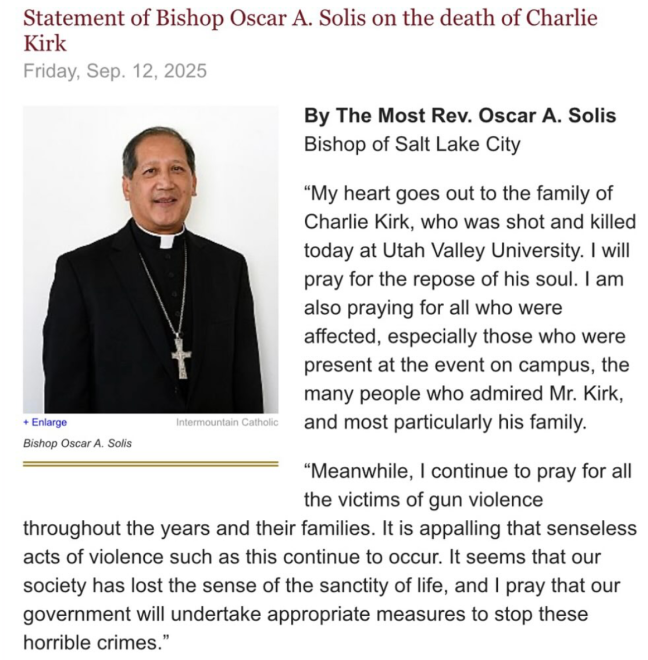
It is a well-meaning statement, don’t get me wrong. But there’s a part in it, at the start of the second paragraph, that rubbed me the wrong way.
Meanwhile, I continue to pray for all the victims of gun violence throughout the years and their families. (Emphasis my own.)
To say that it gave me the Ick (as the kids say these days) is an understatement. I know he’s not originally from the United States, so I tried to give him the benefit of the doubt as to why he might have written what he did. Perhaps he’s well-aware of politically motivated violence in other countries and in his native Philippines in particular.
Or maybe he isn’t aware of it (thank God) and simply tried to appear sympathetic to one particular side of the aisle for some reason. I don’t study the private lives of my religious leaders, partly because it’s none of my business (I don’t think?), and partly because I don’t want that knowledge to bias how I view or interpret their message.

Regardless, I was angry and disappointed, and I couldn’t hold it in any longer. I waited until I cooled off a bit, went over what I wanted to say in my head for a while, and then I actually wrote him a letter expressing my concerns while also correcting some of the misconceptions he brought up. I also abbreviated his letter and turned it into a Letter to the Editor that I also sent to our Diocese’s newspaper.
I interviewed our previous Bishop for my high school newspaper once and volunteered at the Diocese, so I’m not intimidated by reaching out to local authority figures. I cherish it, in fact. I have also contacted my local representatives and senators and I encourage everyone do the same because they need to hear from their constituents.
Without further ado, below are the letters I wrote. I’m not sure if he ever read it (I really hope he did) or that it was published (I hope it was!), but I can tell you that soon after I mailed it, our Diocese’s newspaper announced it would no longer be published in print (just online). I obviously don’t think my Editor letter had any effect on this decision, but I nevertheless wonder whether it was published and perhaps the Bishop didn’t like it, or it caused a ruckus I’m not aware of. Who knows.
My Letter to Bishop Solís in response to his statement on the death of Charlie Kirk
Your Excellency Most Reverend Bishop Solis,
I write to you today with a heavy heart and a deep sense of frustration following your recent statement regarding the tragic shooting of Charlie Kirk. Please know I appreciate your prayers for Charlie, his family, and those affected by this loss. However, I feel strongly compelled to address the deeper implications of what was said, and I do so with the utmost respect for your office and the sincerity with which you serve our community.
I speak not only as a concerned member of this community but as someone whose life has been irreversibly shaped by political violence. Perhaps my perspective is influenced by where I come from, but I feel compelled to share it: I was born and raised in Colombia during the late 1990s and early 2000s—a time when kidnappings and political assassinations were heartbreakingly common. Journalists, candidates, activists, and even their relatives often became targets. My own father was kidnapped once simply because of his innocuous political views and his support for a particular presidential candidate.
It was this kind of brutality that forced our family to begin the process of applying for political asylum while still in Colombia, which ultimately led us to become naturalized citizens of this country—ironically, a place where open debate is meant to be safe, but where, lately, it feels ever more threatened.
In Colombia, despite guns being strictly regulated (where it is almost impossible for law-abiding citizens to own guns but incredibly easy for criminals to do so), it was never the tool that was blamed. Instead, people always blamed the ideology, motivations, intense rhetoric,and, sometimes rightly, the political side fueling the violence that led to these tragedies. This reality has impressed upon me the grave danger of focusing on the instrument of violence, rather than addressing the motivations and rhetoric that spur individuals to act.
With this background, I am profoundly troubled by the framing of this tragedy as simply another case of “gun violence.” This was not an isolated or random killing caused by a mere object; this was a politically motivated assassination.
The shooter acted with deliberate calculation, skill, and—by all appearances—professional marksmanship that cannot be reduced to the presence of a firearm alone. This was the product of corrosive rhetoric, increasingly accepted and amplified by those who oppose voices like Mr. Kirk’s. It is dangerous not only to single out guns as the central evil in these tragedies, but also to do so while failing to address the deeper currents of political hatred and dehumanization fueling such acts.
I am angered, frankly, by the way our society’s leaders—even within the Church—so often default to blaming the tool and not the heart or motives of the person who wields it.
By focusing on “gun violence” as the principal issue, we inadvertently shift the discussion away from the evil intentions—and, in this case, the political animus—that truly took Charlie from us. Such language, even when sourced from compassion, risks dehumanizing both victims and those who disagree, and it can unintentionally embolden those who see violence as a means to silence opposition.
With all due respect, your Excellency, your statement echoes a narrative so many in society are eager to embrace, and I urge you to consider the unintended consequences.
Our Church and its leaders must be examples of moral clarity and courage—especially when the temptation is to adopt the language of popular culture, rather than witness to the harrowing truth. This is not merely “appalling” or “senseless”: It is the predictable result of unchecked political hatred, and unless we address that honestly, we will remain complicit in our silence.
Your Excellency, I implore you: Let us not allow the true lesson of this tragedy to be lost. Let us name evil for what it is, and recognize the dignity and agency of every human being—including not only the victims, but also those whose hearts are twisted by the rhetoric of dehumanization.
Please, in your prayers and public witness, do not be afraid to denounce the real forces at work, and to call on all people—on the Left and Right alike—to reject violence, not by demonizing mere objects, but by cultivating hearts of peace and truth.
My Letter to The Editor of our Diocese’s Catholic newspaper re: The Bishop’s Statement
I write with profound frustration after reading His Excellency Bishop Solis’s statement on the tragic shooting of Charlie Kirk. While I appreciate his prayers, I believe his focus on “gun violence” dangerously obscures the real roots of such tragedies.
Perhaps my perspective is shaped by where I come from. I am originally from Colombia, where, in the late 1990s and early 2000s, kidnappings and political assassinations were tragically common. My own father was kidnapped once for his political views. Our family sought asylum in the United States (while we were still living in Colombia) to escape this nightmare. We ultimately became naturalized citizens of this great country—ironically, a place where open debate is meant to be safe, but where, lately, it feels ever more threatened.
Despite strict gun laws, the Colombian public never blamed the weapon. Instead, they recognized that destructive rhetoric and political hatred fueled these horrors, not the tools themselves.
That is why I am disturbed by the tendency—even among Church leaders—to blame the instrument rather than the deeper evil. This was not a senseless act but the result of targeted, ideological hatred. To ignore this, and to retreat to vague language about “gun violence,” risks dehumanizing the victims and deflects responsibility from those whose rhetoric incites such acts.
Additionally, I urge our leaders not to further alienate faithful Catholics who already feel overlooked or marginalized because of our Conservative stances on issues such as legal immigration and Second Amendment rights. Church leadership must foster unity and understanding, not deepen divides or suggest that some voices matter less. When the Church’s public statements seem to echo only one side, it can further isolate those of us who love both our faith and our country.
Our Church needs moral clarity and courage to denounce what truly threatens us: unchecked hatred and dehumanization. Limiting our response to prayers for victims of “gun violence” fails to confront the true evil at work. Honest acknowledgment is vital if we are ever to break this cycle.
Have you ever written to or met with your Bishop about something you were passionate about?